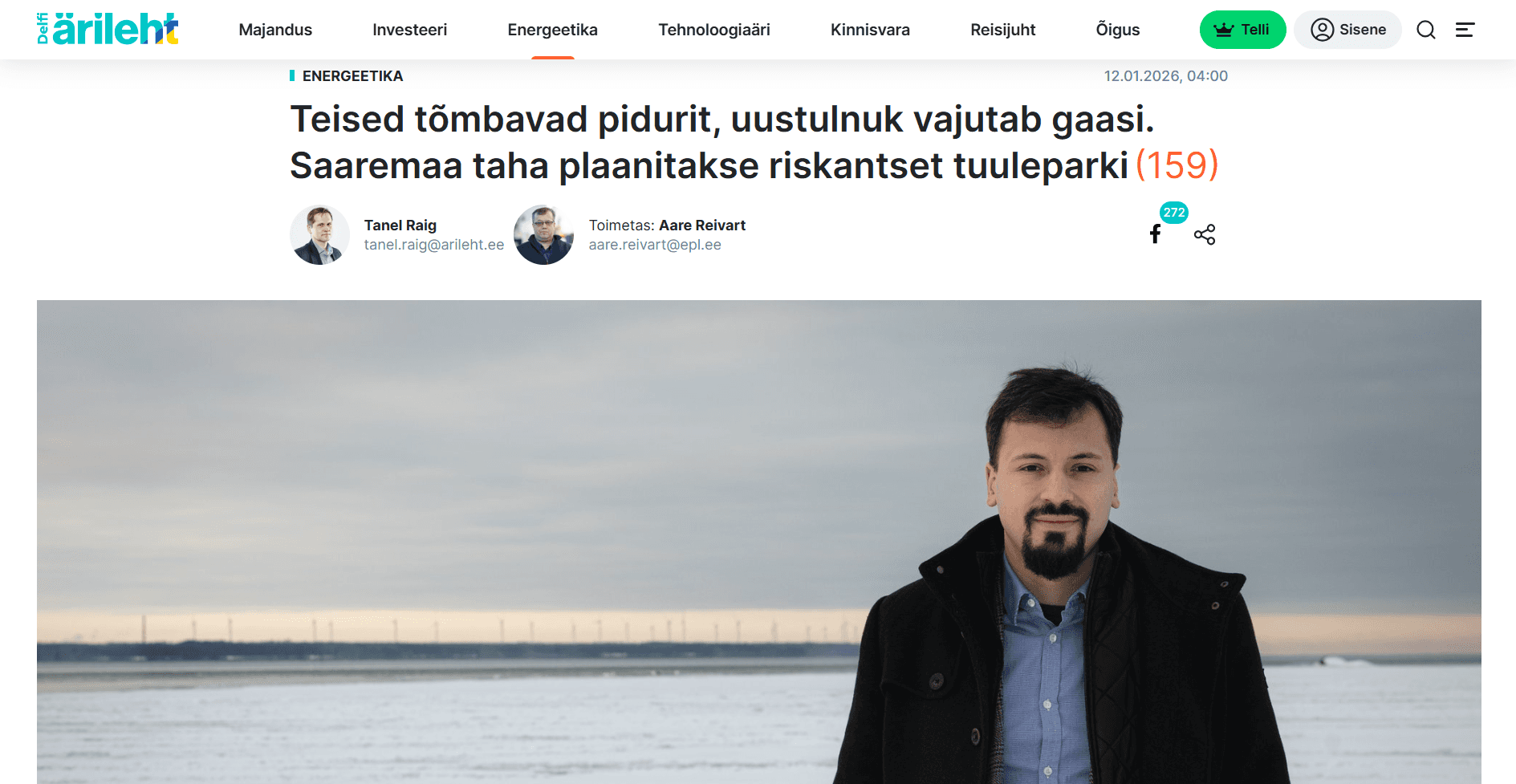
In June 2025, Estonia officially took its renewable energy outlook to a new level when the Consumer Protection and Technical Regulatory Authority (TTJA) launched the preparation of the environmental impact assessment programme for the Avara Tuulepark offshore wind project, previously known as Saare 1.
Under the national maritime spatial plan, this area – initially designated as the “innovation area” for offshore wind west of Saaremaa - was auctioned in early 2025 and now carries its new name: Avara. Further information about the project is available at www.avarawind.ee
Developed by Oxan Energy in partnership with Baltic and European renewable developers under the Avara Consortium, the project will install up to 900 MW of capacity over an 88 km² area located about 60 kilometres west of Saaremaa island and 200 km east off the Swedish coast. The site benefits from stable wind speeds exceeding 9 m/s, remains clear of main commercial shipping routes, and is well positioned for efficient grid connection to mainland Estonia.
“Avara holds a strategic position between Sweden, Finland, Estonia and Latvia,” says Nikon Vidjajev, the project’s Development Director based in Tallinn. “It stands at the centre of the Baltic energy corridor, where floating offshore wind can help balance regional power flows and strengthen long-term energy security.”
First steps
The official start for the preparations of the environmental impact programme on 17 June 2025 marked Avara’s first major milestone and positioned it among Europe’s next-generation renewable initiatives.
Only a day later, at the Seanergy 2025 forum in Paris, the project received the International Cooperation Award, recognising the strength of the cross-border partnership behind its development and Estonia’s emerging role in Europe’s offshore-wind sector.
Building on technological expertise developed in France, Avara represents the transfer of advanced offshore innovation to the Baltic region at a commercial scale. Through this project, knowledge in floating-wind design, environmental engineering and digital marine systems is being adapted to Estonian conditions.
This marks one of the first times that France’s mature floating-wind experience is prepared to be applied at scale in Northern Europe, an achievement already acknowledged internationally.
“This is more than a single wind farm,” Vidjajev notes. “Avara will act as a bridge between Estonian innovation and European know-how, helping the Baltic Sea become a true renewable-energy hub.”
Floating Wind: Unlocking Estonia’s Offshore Potential
Floating offshore wind represents a major engineering advancement, allowing turbines to operate in deeper and windier waters where fixed foundations are less practical. In the Avara area, water depths west of Saaremaa quickly exceed 50 meters, making floating technology particularly relevant. At the same time, future stages of the project may also incorporate fixed-bottom foundations where seabed conditions allow, creating a balanced and adaptable technical concept. The lay-out of the wind farm, including the technology to be used, will be decided after the impact assessment, as well as the environmental and technical studies.
A key advantage of the floating approach is that turbines are assembled in port rather than offshore. This enables safer working conditions, reduces the need for heavy installation of vessels, and provides steady employment and industrial activity for local communities. Once assembled, the completed units are towed to their anchoring locations and connected to the grid.
The modularity of floating platforms offers long-term flexibility—they can be relocated, upgraded, or repurposed according to changing technical or security needs.
“The ability to build and mobilize turbines from port facilities strengthens both our local industry and our energy security,” notes Nikon Vidjajev. “A more mobile energy system is also a safer one for the future.”
Economic and Industrial Benefits
Beyond electricity generation, Avara is expected to strengthen Estonia’s wider maritime and industrial ecosystem. The project will activate a network of local suppliers—from port operators and logistics firms to metalwork, concrete and electrical-assembly specialists—creating a value chain that extends well beyond the coastline.
The preparation of turbine components onshore will give ports a new long-term function as industrial integration hubs, combining engineering, digital control systems and environmental monitoring under one framework. This will by no doubt carry the largest local benefit into the country providing employment and but also helping modernize Estonia’s coastal infrastructure, technical education and building the foundation for future offshore developments in the region.
“Every stage of local preparation adds resilience to our economy,” says Nikon Vidjajev. “The expertise we develop now—in advanced materials, offshore assembly and port logistics—will define Estonia’s role in the Baltic renewable supply chain for years to come.”
Energy Security and Grid Integration
Beyond its technical innovation, Avara will make a tangible contribution to Estonia’s energy independence. With up to 900 MW of capacity, the wind farm could supply a substantial share of Estonia’s current electricity demand, helping replace imported fossil-based generation.
The project supports ongoing grid-strengthening initiatives on Saaremaa, where the reinforcement of 330-kilovolt infrastructure will reduce transmission losses and lower future connection costs for all. It will also allow direct access to both Estonian and Latvian grids. A stronger grid will also enhance system stability, improve electricity-price predictability, and prepare Estonia for regional energy trading within the interconnected Baltic market.
The combined effect is a more resilient, affordable and climate-neutral energy system—in line with the Energy Development Plan 2035 (ENMAK 2035).
From Targets to Realization
Under the ENMAK 2035 framework, Estonia aims for at least 80 percent renewable electricity by 2035 and full climate neutrality by 2050. In practice, both government and industry share an ambition to reach 100 percent renewable generation earlier if market conditions and technology costs allow. Floating-wind capacity like Avara’s brings this goal within reach.
“Every new megawatt of offshore capacity built in Estonia means more stability and more confidence for the whole region,” says Vidjajev. “It proves that the green transition is not only about climate—it’s about economic sovereignty and technological leadership.”
Environmental Responsibility
Floating foundations offer a relatively small physical footprint, reducing disturbance to marine habitats and coastal ecosystems. Also, more floating area near the surface means that marine vegetation and fauna start gathering there. The project’s environmental impact assessment will include detailed studies on bird migration, fish populations and underwater acoustics, ensuring compliance with EU environmental directives.
The consortium’s approach is based on three principles:
agility—to adapt quickly to environmental and technical findings;
dialogue—to maintain transparent cooperation with authorities and communities;
openness—to share both progress and challenges as they emerge.
Local engagement will continue throughout the permitting phase, building trust with Saaremaa residents and maritime stakeholders while promoting a shared vision of sustainable development.
Looking Ahead
The next steps for Avara include completing the environmental impact program, refining engineering design, and continuing stakeholder dialogue. Construction could begin once authorizations are granted later this decade.
When operational, the wind farm will deliver clean electricity to tens of thousands of homes and businesses while anchoring Estonia as a regional pioneer in floating offshore technology.
“Avara’s location was chosen deliberately,” explains Nikon Vidjajev. “It lies beyond the visible horizon of Saaremaa, so it does not affect the island’s landscape. But there is also a strategic reason — today, most of Estonia’s power generation is concentrated near the eastern border with Russia, in Ida-Virumaa. By developing offshore capacity further west, we help balance the country’s energy system, strengthen security, and place production where it is naturally most powerful — in the open Baltic Sea.”